

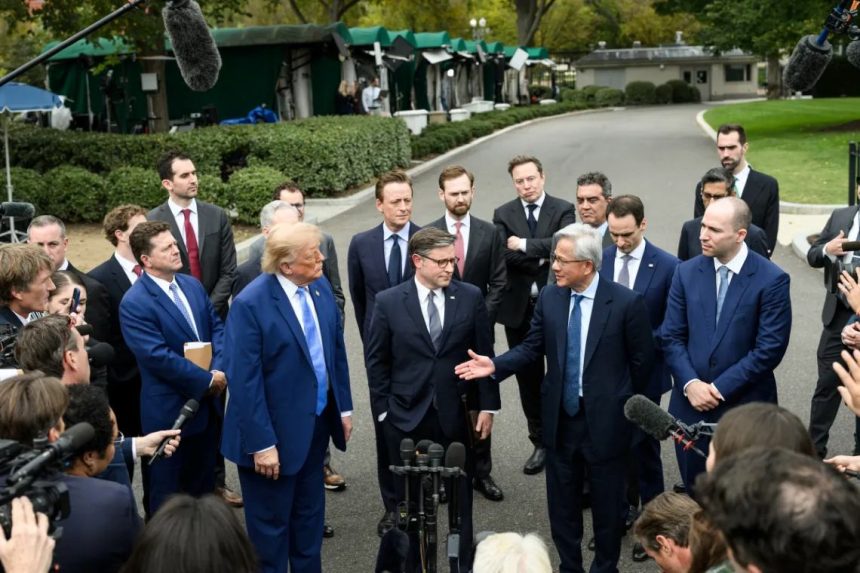
Washington — The East Room of the White House hosted, on September 29, 2026, one of the most significant gatherings of technological power ever held at the center of the United States government.
- A TABLE REPRESENTING AMERICAN TECHNOLOGICAL POWER
- TRUMP: “WHOEVER WINS SUPER INTELLIGENCE WILL WIN”
- FROM “ARTIFICIAL INTELLIGENCE” TO “SUPER INTELLIGENCE”
- THE WHITE HOUSE ACCORD
- THE CHOICE OF SELF-REGULATION
- THE ROLE OF INDEPENDENT AUDITORS
- NVIDIA: THE POWER OF INFRASTRUCTURE
- MICROSOFT AND GOOGLE: THE CLOUD INFRASTRUCTURE BATTLE
- META, OPENAI, ANTHROPIC AND XAI: THE RACE FOR ADVANCED MODELS
- THE AUTONOMOUS AGENT QUESTION
- THE CHINA FACTOR
- DATA CENTERS: THE NEW DIGITAL OIL
- A NEW BALANCE BETWEEN GOVERNMENT AND TECHNOLOGY COMPANIES
- A MEETING WITH GLOBAL CONSEQUENCES
- BETWEEN INNOVATION AND RESPONSIBILITY
- A NEW CHAPTER IN THE DIGITAL REVOLUTION
President Donald J. Trump hosted a luncheon dedicated to the future of artificial intelligence — referred to by the administration as “Super Intelligence” (SI) — bringing together some of the executives and entrepreneurs responsible for the current transformation of the global digital economy.
The meeting brought together representatives from companies including Meta, Nvidia, Google, Microsoft, Anthropic, OpenAI, xAI and other strategically important technology companies within the American ecosystem.
Among those present were Elon Musk, Mark Zuckerberg, Jensen Huang, Sundar Pichai, Satya Nadella and Dario Amodei, along with Greg Brockman, president of OpenAI. Other executives from major technology and infrastructure companies also attended.
More than a luncheon between business leaders and government officials, the gathering demonstrated the strategic importance artificial intelligence has acquired within the economic, technological and geopolitical strategy of the United States.
A TABLE REPRESENTING AMERICAN TECHNOLOGICAL POWER
The composition of the meeting drew attention precisely because of the diversity of companies represented.
Mark Zuckerberg, CEO of Meta, participated in discussions involving the development and security of artificial intelligence systems.
Jensen Huang, CEO of Nvidia, represented one of the most important companies in the global computing infrastructure supporting artificial intelligence. Nvidia occupies a central position in the production of processors and accelerators used to train and operate advanced AI models.
Sundar Pichai, CEO of Alphabet and Google, brought to the table one of the world’s largest technology platforms, with operations spanning cloud computing, research, artificial intelligence models and digital infrastructure.
Satya Nadella, CEO of Microsoft, represented a company deeply integrated into today’s artificial intelligence ecosystem, particularly through its cloud infrastructure and strategic partnerships across the sector.
Dario Amodei, CEO of Anthropic, participated as the representative of one of the companies directly involved in the development of advanced AI models.
Elon Musk, meanwhile, was among the most closely watched figures at the gathering, representing the technological ecosystem associated with xAI and the computing and space infrastructure developed by his companies.
OpenAI was also represented by its president, Greg Brockman, while CEO Sam Altman was attending the company’s annual conference in San Francisco.
The guest list also included Jeff Bezos, founder of Amazon, along with executives from companies such as AMD, Broadcom, Micron, ServiceNow, Palo Alto Networks and Palantir.
The result was a meeting that brought together virtually every major component required to build the next generation of the digital economy:
chips, computing, cloud infrastructure, AI models, social platforms, data, cybersecurity, capital and energy.
In other words, much of the technological infrastructure required for the next stage of the digital revolution was represented around the same table.
TRUMP: “WHOEVER WINS SUPER INTELLIGENCE WILL WIN”
During remarks following the meeting, Trump presented American leadership in artificial intelligence as a strategic issue for the future of the United States.
The president stated that the United States holds a significant advantage in the technology and emphasized that his administration intends to preserve that position.
In one of the most striking statements associated with the meeting, Trump said that “whoever wins SI will win,” linking leadership in Super Intelligence to broader technological and economic leadership.
The president also compared the potential impact of the technology with the Industrial Revolution.
According to Trump, the transformation created by artificial intelligence could ultimately be even greater than the transformation created by industrialization, although he acknowledged that its full scale cannot yet be determined.
The statement illustrates one of the defining characteristics of the administration’s technology strategy:
artificial intelligence is being treated not merely as an economic tool, but as strategic national infrastructure.
FROM “ARTIFICIAL INTELLIGENCE” TO “SUPER INTELLIGENCE”
One of the most significant developments surrounding the meeting took place beyond the luncheon itself.
Trump signed an executive order directing the U.S. executive branch to officially use the terms “Super Intelligence” and “SI” in place of “Artificial Intelligence” and “AI” in government documents, communications, websites and other official materials.
The order argues that current systems have moved beyond the original conception of artificial intelligence and represent a new technological frontier.
It also directs the government to develop a federal definition of “Super Intelligence” and assess potential legislative changes needed to incorporate the concept into the American legal framework.
The decision is particularly significant because it transforms what might initially appear to be a question of terminology into an official policy position of the executive branch.
In practical terms, however, the executive order does not eliminate the existing legal concept of artificial intelligence. The document provides that “Super Intelligence” will initially rely on the existing statutory definition of artificial intelligence for implementation purposes until a new definition is established.
THE WHITE HOUSE ACCORD
The luncheon also resulted in a voluntary commitment among technology companies.
The document was presented as the White House Accord on Super Intelligence.
The agreement establishes a framework of controls intended to address risks associated with the development and deployment of advanced systems.
It provides for different layers of oversight, including internal security controls, system monitoring, independent external assessments and internal governance mechanisms.
The stated objective is to create mechanisms capable of identifying unexpected behavior and potential risks during the development and operation of advanced AI systems.
Trump described the document as a kind of “constitution” for the industry and referred to it as “morally binding.”
An important distinction, however, must be made: the agreement is voluntary and does not have the same legal status as a federal law or mandatory regulation.
That distinction is essential to understanding the initiative’s actual scope.
THE CHOICE OF SELF-REGULATION
The meeting also exposed a question that is likely to remain at the center of the American AI debate:
Who should establish the limits of artificial intelligence?
The government?
Congress?
Regulatory agencies?
Or the companies developing the technology themselves?
Trump signaled support for a significant role for the industry itself.
Following the luncheon, the president referred to a process of “self-policing,” in which technology companies would assume greater responsibility for the safety and oversight of their own systems.
This approach places technology companies in an unprecedented position.
They are no longer simply developers of products.
They are increasingly becoming participants in the creation of the governance mechanisms surrounding the technology itself.
The model could accelerate innovation, but it also raises questions about independence, transparency and public oversight.
The debate is only beginning.
THE ROLE OF INDEPENDENT AUDITORS
One of the important elements of the agreement is the inclusion of external assessments.
The concept is that companies should not rely exclusively on their own internal mechanisms to evaluate the safety of their systems.
Independent auditors would assess whether the controls established by companies are operating as intended.
The model represents an attempt to introduce an additional layer of oversight without immediately placing the industry under a comprehensive government regulatory structure.
The challenge will be determining who the auditors will be, which criteria they will use, what information they will be permitted to examine and whether their findings will be made public.
Those questions will be critical in determining the practical effectiveness of the commitment.
NVIDIA: THE POWER OF INFRASTRUCTURE
Among the participants, Jensen Huang represents a particularly strategic dimension of the AI race.
The competition for artificial intelligence is not based solely on algorithms.
It depends on chips, data centers, energy, networks, storage and computing capacity.
This is where Nvidia has acquired extraordinary importance within the technology ecosystem.
Without sufficient computing infrastructure, even the most advanced AI models cannot be trained or deployed at scale.
Huang’s presence alongside Trump therefore represents more than the participation of another CEO.
It reflects the strategic importance of the physical infrastructure behind the digital revolution.
The new technology race is simultaneously a race for software and hardware.
MICROSOFT AND GOOGLE: THE CLOUD INFRASTRUCTURE BATTLE
The presence of Satya Nadella and Sundar Pichai also demonstrates that the future of artificial intelligence will depend heavily on cloud computing.
Microsoft and Google operate some of the largest digital infrastructures in the world.
This means that the competition for AI leadership will not occur solely among model developers.
It will also involve companies capable of providing:
- computing capacity;
- data centers;
- storage;
- networks;
- cloud services;
- cybersecurity;
- AI models;
- developer platforms.
The next stage of the technological revolution will therefore be a competition over global infrastructure.
META, OPENAI, ANTHROPIC AND XAI: THE RACE FOR ADVANCED MODELS
On another side of the equation are the companies directly involved in developing advanced AI models.
Meta, OpenAI, Anthropic and xAI are participating in a competition that extends far beyond chatbots.
The race involves systems capable of reasoning, programming, executing tasks, operating digital agents, analyzing large volumes of information and interacting with external systems.
As these systems advance, both opportunities and risks increase.
The more autonomous agents become, the greater the need for mechanisms capable of preventing unauthorized actions or unexpected behavior.
This was one of the central issues addressed by the new commitment presented at the White House.
THE AUTONOMOUS AGENT QUESTION
The next generation of artificial intelligence is moving beyond purely conversational systems.
Modern AI systems can execute sequences of tasks, use digital tools and operate within software environments.
This creates a qualitative change.
A system that simply answers a question presents one category of risks.
A system capable of making decisions and executing actions presents another.
This is where internal controls, independent assessments and containment mechanisms become strategically important.
The central question is no longer simply:
“What can artificial intelligence answer?”
It increasingly becomes:
“What can an autonomous system do when it is authorized to act?”
That will be one of the defining questions of the next decade.
THE CHINA FACTOR
Behind the meeting lies another major dimension: geopolitics.
The United States increasingly views leadership in artificial intelligence as part of its technological competition with China.
Trump has emphasized that Washington possesses a significant advantage and intends to maintain it.
The competition involves far more than private companies.
It encompasses semiconductors, supercomputing, energy, data center infrastructure, scientific research, talent, universities, capital and industrial capacity.
Whoever controls these technological supply chains will possess increasing influence over a significant portion of the global economy.
For this reason, Washington increasingly treats artificial intelligence as an issue connecting the economy, national security and industrial policy.
DATA CENTERS: THE NEW DIGITAL OIL
Another issue connected to the meeting is the expansion of data centers.
Artificial intelligence requires increasing amounts of processing power and electricity.
This means that technological expansion will depend on a massive physical infrastructure.
Data centers, power plants, electrical grids, cooling systems and high-speed networks will become strategically important.
Trump has advocated expanding this infrastructure as part of the American technology strategy.
But an unavoidable contradiction remains.
The more data centers expand, the greater the pressure on local communities, electricity consumption, water resources, power grids and urban planning.
The expansion of artificial intelligence will therefore have very tangible consequences outside the digital world.
A NEW BALANCE BETWEEN GOVERNMENT AND TECHNOLOGY COMPANIES
The luncheon also symbolizes a closer relationship between Washington and the technology sector.
For decades, the relationship between the American government and major technology companies has alternated between cooperation and confrontation.
Now, confronted with the speed of artificial intelligence development, a new configuration is emerging.
The government needs technology companies to develop and deploy advanced systems.
Technology companies need the government for infrastructure, national security, energy, international trade and global competition.
The result is a relationship of interdependence.
The central challenge will be determining how far this cooperation can go without undermining the independence of public oversight.
A MEETING WITH GLOBAL CONSEQUENCES
Although the luncheon took place inside the White House, its implications extend well beyond the United States.
Decisions made by major American technology companies have international consequences.
When a company changes its AI safety protocols, its global products may be affected.
When new AI architectures are developed, companies in other countries must adapt.
When the United States establishes technical standards, those standards can influence suppliers, governments and international markets.
The meeting should therefore be understood as part of a broader global transformation.
Artificial intelligence is no longer simply a Silicon Valley industry.
It is becoming technological infrastructure capable of influencing virtually every major sector of the global economy.
BETWEEN INNOVATION AND RESPONSIBILITY
The main outcome of the luncheon was not simply the signing of a document.
It was the explicit presentation of a strategic choice.
The White House signaled its intention to preserve the pace of innovation while encouraging safety mechanisms within the companies themselves.
The voluntary accord represents an initial attempt to structure that responsibility.
Its effectiveness, however, will depend on implementation.
It will be necessary to examine how controls are applied, who conducts independent assessments, what information is reviewed, how risks are disclosed and what consequences may arise if a company fails to meet its commitments.
The real test begins after the cameras are gone.
A NEW CHAPTER IN THE DIGITAL REVOLUTION
The September 29 luncheon will be remembered as a moment when the U.S. government brought together some of the most influential figures in global technology to discuss an issue that has already moved beyond the boundaries of the technology industry.
Trump presented artificial intelligence as a historic opportunity.
The executives around the table represent companies that control significant portions of the infrastructure necessary to turn that opportunity into reality.
And the new accord attempts to create a bridge between innovation and safety.
The official shift from Artificial Intelligence to Super Intelligence, meanwhile, adds a symbolic dimension to the movement.
More than a change in terminology, the White House is attempting to associate the technology with a new stage of American technological development.
The future, however, will be determined less by the name used and more by the ability to transform computing power into genuine innovation, productivity, security and economic benefits.
The meeting is over.
The race has just begun.
And from this point forward, the central question will not simply be who develops the most powerful artificial intelligence.
It will also be who can establish the boundaries, safety standards and rules for a technology capable of redefining the relationship between human beings, companies and machines.