


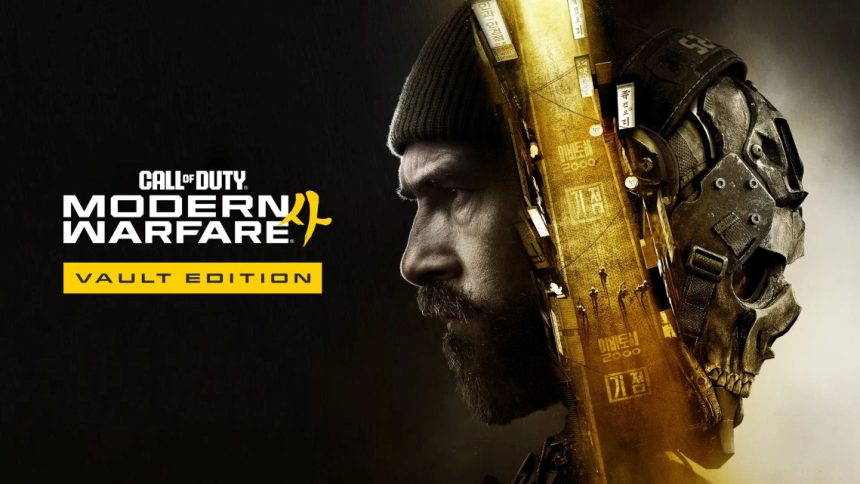
From The Ward, Episode 1 offers a behind-the-scenes look at a production built around narrative ambition, military authenticity, technological innovation, and the human cost of conflict
The video game industry has entered an era in which major franchises are no longer competing solely on graphics, technical performance, or player numbers. The battlefield has expanded. Narrative depth, character development, artistic direction, authenticity, immersion, and the ability to create a lasting cultural impact have become equally important elements in determining the success of a major release.
- A Franchise Entering a New Era
- The Theater of War: Korea
- Price and the Conflict With the System
- Warfare as a Human Experience
- Technology in Service of Storytelling
- From The Ward and the Value of the Creative Process
- The Challenge of Returning to the Roots
- The Future of Modern Warfare
- ORIGH INTERNATIONAL EDITORIAL
It is within this environment that Infinity Ward presents “A New Chapter of Modern Warfare – From The Ward, Episode 1,” an official behind-the-scenes feature dedicated to the development of Call of Duty: Modern Warfare 4.
More than a conventional promotional piece, the episode offers an inside look at the creative vision behind the next chapter of Modern Warfare, highlighting the campaign’s “Theater of War: Korea,” its narrative direction, character development, motion capture, artistic vision, and the creative process involved in bringing the new installment to life.
The return of Infinity Ward to the roots of Modern Warfare therefore carries significance beyond simple franchise continuity. It represents an attempt to recover the elements that helped define the series — contemporary warfare, military operations, geopolitical tension, morally complex characters, and high-impact storytelling — while adapting those foundations to the expectations of a new generation of players.

A Franchise Entering a New Era
Call of Duty has evolved into one of the most influential brands in the history of interactive entertainment. Over the years, the franchise has helped establish standards for cinematic campaigns, first-person combat, competitive multiplayer, sound design, character animation, and the visual representation of modern warfare.
Within that larger universe, Modern Warfare occupies a particularly important position.
The sub-franchise has traditionally attempted to place players closer to contemporary conflicts through a combination of special operations, intelligence missions, military strategy, political instability, and personal dilemmas.
Its stories have rarely been limited to the battlefield itself.
They have also explored the consequences of decisions made by soldiers, commanders, intelligence agencies, and political institutions.
That dimension appears to be receiving renewed attention in Modern Warfare 4.
According to the presentation surrounding From The Ward, Infinity Ward intends to place new stories at the center of the experience, taking players into a setting defined by collapsing front lines and Korean trenches while simultaneously exploring the internal conflict of Captain John Price.
The choice is significant.
Price is not simply another recurring character in the franchise. Over the history of Modern Warfare, he has become one of its defining figures — a character shaped by duty, loyalty, sacrifice, command, and survival.
By placing his internal struggle alongside the external conflict, the new campaign appears to be expanding the meaning of warfare beyond military confrontation.
The Theater of War: Korea
One of the central elements highlighted in From The Ward, Episode 1 is the “Theater of War: Korea,” a setting that becomes an important component of the campaign.
The choice opens considerable narrative possibilities.
A war environment is not merely a backdrop. It can determine how characters behave, how military operations unfold, how information is interpreted, and how the player experiences uncertainty.
The image of collapsing front lines and trench warfare immediately creates a different atmosphere from the more familiar urban and covert-operation environments associated with contemporary Modern Warfare.
Yet visual authenticity alone will not be enough.
For a modern AAA production, building a convincing theater of war requires the integration of environment design, lighting, sound, animation, artificial intelligence, visual effects, level design, and narrative direction.
The objective is not simply to make the battlefield look realistic.
It is to make the player believe that the battlefield exists beyond what is immediately visible.
That distinction could prove essential to Modern Warfare 4.
Price and the Conflict With the System
Perhaps the most intriguing narrative element presented by Infinity Ward is the evolution of John Price.
The description surrounding the episode points toward a protagonist who is not only fighting enemies but also confronting the system that shaped him.
That direction could represent a meaningful shift in the way the franchise approaches its central character.
Rather than presenting warfare exclusively as a confrontation between opposing military forces, Modern Warfare 4 appears positioned to explore the structures behind the conflict.
Who makes the decisions?
Who carries them out?
What happens when loyalty conflicts with personal conviction?
And how far can a soldier remain faithful to an institution when that institution begins to contradict the principles that originally defined him?
These questions are particularly appropriate for the Modern Warfare universe.
The strength of the franchise has never been limited to weapons, explosions, or military spectacle.
Its greatest narrative potential lies in the tension between individuals and systems.
Price can therefore function as the bridge between the franchise’s past and its future.
Warfare as a Human Experience
The technological evolution of gaming has created an interesting paradox.
Games have become increasingly realistic, but visual realism alone is no longer sufficient.
A ruined city can look authentic.
A battlefield can be rendered with extraordinary detail.
A character can move with near-photorealistic precision.
But the player still has to believe in the world.
This is where motion capture, performance direction, facial animation, sound design, cinematography, and artistic direction become strategically important.
From The Ward, Episode 1 places considerable emphasis on that production process.
Infinity Ward presents the creation of Modern Warfare 4 as a collaborative effort involving multiple disciplines working toward a unified experience.
Motion capture, for example, is not merely a technical method for creating realistic movement. It can communicate body language, hesitation, fear, exhaustion, aggression, vulnerability, and emotional tension.
For a campaign built around character-driven storytelling, these details can be just as important as the weapons themselves.
Technology in Service of Storytelling
One of the greatest challenges facing modern AAA development is ensuring that technology serves the narrative rather than replacing it.
Cutting-edge graphics can generate immediate visual impact. But technological spectacle alone rarely determines whether a campaign becomes memorable.
What remains with players is the experience.
This is why the relationship between technology, artistic direction, and narrative design becomes so important in Modern Warfare 4.
Today’s audience is accustomed to sophisticated digital cinematography, highly detailed environments, advanced animation, realistic soundscapes, and increasingly complex interactive experiences.
The expectations are therefore significantly higher.
Players do not simply want to watch cinematic sequences.
They want to participate in them.
They do not merely want to receive a story.
They want to feel that their actions exist within that story.
The boundary between cinema and interactive entertainment has always been one of Call of Duty’s defining territories.
Modern Warfare 4 now has the opportunity to push that boundary even further.
From The Ward and the Value of the Creative Process
The From The Ward series also deserves attention for another reason.
By opening the doors to the development process, Infinity Ward is giving players a different relationship with the franchise.
For decades, audiences primarily experienced games as finished products.
Today, however, players increasingly want to understand how those products are created.
Developer documentaries, production diaries, interviews, motion-capture footage, concept art, technical demonstrations, and behind-the-scenes material have become important components of the communication strategy surrounding major releases.
This approach changes the relationship between developer and audience.
Players are no longer seeing only the final character, environment, or combat sequence.
They are being introduced to the people and creative decisions responsible for constructing that world.
For Modern Warfare 4, this is particularly relevant.
The franchise has a highly engaged audience that already understands its characters, history, visual identity, and storytelling conventions.
Showing how the next chapter is being created effectively invites that audience to witness the evolution of the franchise before experiencing it firsthand.
The Challenge of Returning to the Roots
There is, however, an obvious creative challenge.
Returning to a franchise’s roots does not necessarily mean repeating what worked in the past.
The greatest risk for a long-running property is turning nostalgia into a formula.
Players already know Price.
They recognize the visual language of Modern Warfare.
They understand the structure of Call of Duty campaigns.
They know the rhythm of cinematic action, special operations, large-scale confrontations, and military storytelling.
That means Modern Warfare 4 must demonstrate that its return to the roots of the franchise is also an evolution.
The real question is not whether Infinity Ward can reproduce the past.
It is whether the studio can reinterpret it.
A mature franchise must respect its history without becoming imprisoned by it.
The Future of Modern Warfare
The first episode of From The Ward presents a creative direction seemingly built around three fundamental pillars:
Narrative. Authenticity. Technological innovation.
The relationship between these three elements may ultimately determine the impact of Modern Warfare 4.
The narrative must convince players that there is something genuinely new to discover.
The authenticity must make the military environment coherent and credible.
And technology must increase immersion without overwhelming the story.
The balance will be critical.
In an increasingly competitive industry, a major franchise cannot rely solely on its name.
The name brings the audience.
The experience determines whether that audience stays.
ORIGH INTERNATIONAL EDITORIAL
Modern Warfare 4 arrives in a gaming industry fundamentally different from the one that produced the earliest chapters of the franchise.
Video games are no longer simply entertainment products.
They have become global cultural phenomena, interactive cinematic experiences, social platforms, technological showcases, and increasingly sophisticated forms of storytelling.
Infinity Ward therefore appears to be taking a strategically important approach: looking backward to recover the identity of Modern Warfare, while simultaneously looking forward to redefine what that identity can mean for a new generation.
From The Ward, Episode 1 matters because it allows audiences to see the process before the final product.
The war presented by Infinity Ward is not only the war taking place across Korean trenches and collapsing front lines.
There is also a creative battle taking place behind the scenes: finding new stories for familiar characters, preserving the identity of a historic franchise, embracing technological evolution, and proving that Modern Warfare still has something meaningful to say.
Price may therefore represent more than a protagonist.
He may represent the franchise itself.
A character shaped by a system, forced to confront that system, and ultimately faced with the question of whether survival requires obedience — or transformation.
That may be the central question surrounding Modern Warfare 4.
The future of Modern Warfare will not be determined simply by how far the franchise can move forward, but by whether Infinity Ward can turn its own roots into the foundation for a new era.
And if From The Ward, Episode 1 is the first window into that journey, the definitive judgment will come when the audience leaves the development room behind and enters the battlefield.
Warfare Without Limits: Call of Duty®: Modern Warfare® 4 launches on October 23, 2026. Lock in your preferred edition now to secure a full slate of rewards and bonus content available with digital pre-orders on console and pre-purchases on PC. See the full breakdown of included benefits