

Historic reception of the American president signals a new chapter in Washington–Beijing relations. Ahead of the APEC Leaders’ Summit, the two world powers place international trade, artificial intelligence, technology, security, and geopolitical balance at the center of discussions that could shape the future of the global economy.
SHENZHEN, CHINA — NOVEMBER 18, 2026
- A HISTORIC RECEPTION: XI JINPING WELCOMES TRUMP AT THE AIRPORT
- TRUMP AND XI: A RELATIONSHIP THAT COULD SHAPE THE COMING YEARS
- SHENZHEN: THE CITY THAT REPRESENTS CHINA’S TECHNOLOGICAL FUTURE
- APEC AND THE FUTURE OF INTERNATIONAL TRADE
- ARTIFICIAL INTELLIGENCE AND SEMICONDUCTORS: THE REAL TECHNOLOGICAL BATTLEFIELD
- THE RUSSIA FACTOR: TRUMP, XI, AND PUTIN ON THE SAME INTERNATIONAL STAGE
- THE ECONOMIC IMPACT ON THE REST OF THE WORLD
- A NEW CHAPTER IN INTERNATIONAL DIPLOMACY
- ORIGH INTERNATIONAL EDITORIAL: THE WORLD IS WATCHING SHENZHEN
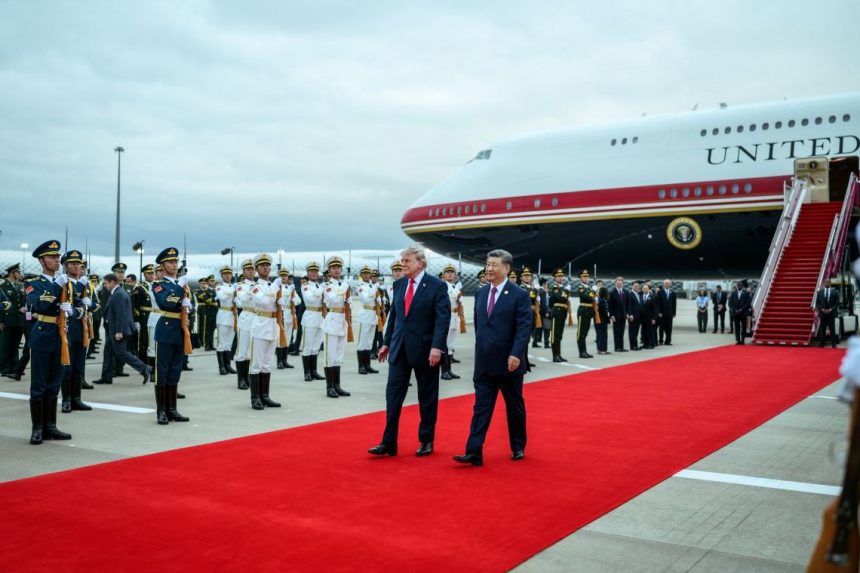
The arrival of United States President Donald J. Trump in Shenzhen, China, on Wednesday (November 18), marked one of the most significant diplomatic moments of the 2026 international agenda. Personally welcomed by Chinese President Xi Jinping at Shenzhen Bao’an International Airport, the American leader received a high-profile official reception, featuring a formal ceremony, national flags, military honors, and a public display of cordiality that immediately attracted international attention.
Xi Jinping’s decision to personally welcome Trump was more than a diplomatic formality. It represented a carefully orchestrated political gesture, particularly given the history of trade disputes, technological tensions, and strategic disagreements between the world’s two largest economic powers.
Images of the two presidents standing face-to-face, shaking hands, and walking together along the red carpet quickly became the defining symbol of the American president’s arrival. Against a backdrop of international competition, trade tariffs, and technological rivalry, the reception conveyed a clear message: Washington and Beijing continue to recognize the strategic importance of maintaining direct channels of communication.
The visit takes place alongside the 33rd Asia-Pacific Economic Cooperation (APEC) Economic Leaders’ Meeting, scheduled for November 18–19 in Shenzhen, under Xi Jinping’s leadership and guided by the theme “Building an Asia-Pacific Community to Prosper Together.”
More than simply attending an international summit, Trump arrives in China at a moment when decisions made by these two powers could directly influence global trade, investment flows, energy security, and technological development across virtually every region of the world.
A HISTORIC RECEPTION: XI JINPING WELCOMES TRUMP AT THE AIRPORT
The arrival ceremony immediately attracted attention because of its political significance.
Xi Jinping chose to personally welcome Donald Trump on the airport tarmac, greeting the American president as he stepped off Air Force One.
The reception featured a high-profile diplomatic arrangement, including Chinese and American officials, military representatives, national flags, musical performances, and a formal display of mutual respect between the two countries.
Trump descended from the aircraft, greeted Xi Jinping, and stood alongside the Chinese president during the national anthems. The American president also saluted during the playing of the United States national anthem.
The two leaders exchanged greetings, briefly embraced, and walked together along the red carpet.
One particularly significant detail was the diplomatic reciprocity.
In September 2026, during Xi Jinping’s state visit to Washington, Donald Trump had also personally welcomed the Chinese president upon his arrival in the United States.
Now, Xi was returning that gesture on Chinese soil.
The decision carries additional historical significance because personal airport receptions of foreign heads of state by China’s top leader are considered exceptional diplomatic gestures.
Historical comparisons have also drawn attention to the 1959 reception, when Mao Zedong personally welcomed Soviet leader Nikita Khrushchev.
Xi’s gesture, therefore, should not be interpreted simply as an expression of courtesy. It also demonstrates the political importance Beijing attaches to its relationship with Washington.
TRUMP AND XI: A RELATIONSHIP THAT COULD SHAPE THE COMING YEARS
The United States and China represent two of the central forces driving the international economy.
On one side, Washington maintains a leading position in global finance, technology, defense, artificial intelligence, and diplomatic influence. On the other, Beijing has established itself as a strategic force in manufacturing, international trade, infrastructure, industrial production, energy, and global supply chains.
However, this relationship is far from straightforward.
Over recent years, the two countries have faced trade disputes, technological restrictions, tariffs, industrial competition, and disagreements involving international security.
The race for leadership in artificial intelligence, semiconductors, advanced computing, digital infrastructure, and defense technologies has become one of the most important sources of tension.
This is the context in which Trump’s arrival in Shenzhen assumes particular importance.
Diplomacy between the two presidents must address competing interests that frequently collide. At the same time, both governments recognize that an economic rupture between the world’s two largest powers could have significant consequences for international trade and global financial stability.
Diplomatic engagement does not mean the disappearance of disagreements. Rather, it demonstrates a strategic interest in managing those differences through direct negotiations.
SHENZHEN: THE CITY THAT REPRESENTS CHINA’S TECHNOLOGICAL FUTURE
The choice of Shenzhen as the host city for APEC also carries special significance.
Located in China’s Guangdong province, Shenzhen has evolved from a small fishing center into one of the world’s leading hubs for technology, innovation, electronics manufacturing, and business development.
The city represents one of the most prominent examples of China’s economic modernization strategy.
It is home to major technology companies and plays an important role in electronics manufacturing, telecommunications, robotics, artificial intelligence, and industrial components.
Welcoming Donald Trump in this environment carries considerable symbolic weight.
The competition between the United States and China is no longer confined to traditional markets. It is increasingly concentrated in the technologies that will determine productivity, industrial capacity, and national security over the coming decades.
Artificial intelligence has become one of the principal battlegrounds.
American and Chinese companies are competing to develop advanced models, computing infrastructure, specialized chips, autonomous systems, and industrial applications.
In this context, Shenzhen offers a tangible representation of China’s ability to transform technological innovation into large-scale industrial production.
For Washington, understanding Beijing’s advances in these sectors is essential to the broader American strategy of maintaining technological leadership.
APEC AND THE FUTURE OF INTERNATIONAL TRADE
Trump’s arrival coincides with the 33rd APEC Leaders’ Summit, bringing together representatives of some of the most influential economies across the Asia-Pacific region.
The Leaders’ Meeting takes place on November 18–19, while the APEC CEO Summit is scheduled for November 17–18.
The theme selected under China’s presidency — “Building an Asia-Pacific Community to Prosper Together” — emphasizes economic integration, trade cooperation, and regional development.
The Asia-Pacific region includes some of the world’s most important economies and occupies a central position in global manufacturing, production, and distribution networks.
For China, APEC represents an opportunity to strengthen its position as a major center of international economic integration.
For the United States, Trump’s participation provides an opportunity to reaffirm American engagement in the region and defend strategic interests related to trade, economic security, and industrial competitiveness.
During the summit’s opening activities, Xi Jinping emphasized open trade, broader market access, and regional economic cooperation.
The message also highlighted differences in economic approaches, particularly when compared with American trade policy, which has increasingly emphasized national economic interests and the use of tariffs as negotiating instruments.
The central question is how far these two approaches can move toward a common ground.
ARTIFICIAL INTELLIGENCE AND SEMICONDUCTORS: THE REAL TECHNOLOGICAL BATTLEFIELD
Among the most important issues connecting Washington and Beijing is control over the future of artificial intelligence.
The development of advanced systems depends on an extraordinarily complex technological infrastructure involving semiconductors, specialized processors, data centers, electricity generation, communication networks, and billions of dollars in investment.
The United States is home to companies operating at the forefront of this transformation, while China is investing heavily in building an increasingly independent technological ecosystem.
Semiconductors are particularly sensitive.
American restrictions on the export of certain advanced chips and semiconductor manufacturing equipment have become strategic instruments used by Washington to limit China’s access to technologies considered essential for high-performance computing.
Beijing, meanwhile, is working to reduce its dependence on foreign suppliers and strengthen its domestic semiconductor industry.
This competition extends far beyond corporate commercial interests.
At stake is each country’s ability to establish technological standards, control strategic components, and influence the next generation of the digital economy.
Any potential agreement between Trump and Xi on technology could have important consequences for companies, investors, and international markets.
However, expectations of significant policy changes must be approached cautiously. A cordial diplomatic reception does not automatically translate into a transformation of either country’s technological policies.
THE RUSSIA FACTOR: TRUMP, XI, AND PUTIN ON THE SAME INTERNATIONAL STAGE
Another element adding to the significance of the American visit is the prospect of a trilateral meeting involving Donald Trump, Xi Jinping, and Vladimir Putin.
The possibility of bringing together the three presidents places Shenzhen at the center of an extraordinary diplomatic configuration.
The United States, China, and Russia have different strategic interests, but all three exercise considerable influence over international security, energy markets, global trade, regional conflicts, and the international balance of power.
A trilateral meeting is scheduled for Thursday (November 19), alongside the international summit’s diplomatic engagements.
The prospect has attracted attention because it would bring together three leaders representing countries with significant military, economic, and diplomatic capabilities.
Potential discussion topics include international stability, nuclear issues, ongoing conflicts, energy security, and relations among the world’s leading powers.
Discussions about reducing nuclear arsenals have also been mentioned by American representatives.
It is important to emphasize that the possibility of a meeting does not guarantee concrete agreements. Differences between Washington, Moscow, and Beijing remain substantial and involve strategic interests that cannot be resolved through diplomatic gestures alone.
Nevertheless, the willingness to bring these three presidents together represents a development of considerable international significance.
The world is watching not only for signs of rapprochement among the leaders but also for the limits of such an initiative.
THE ECONOMIC IMPACT ON THE REST OF THE WORLD
Decisions made by the United States and China do not remain confined within their national borders.
They directly influence the functioning of the global economy.
A reduction in trade tensions could support investment, improve prospects for certain industrial sectors, and provide greater predictability for international supply chains.
On the other hand, an escalation of trade and technological restrictions could increase production costs, put pressure on financial markets, and force multinational companies to reorganize their operations.
Emerging economies are also following the meeting closely.
Brazil, for example, maintains important commercial relationships with both Washington and Beijing.
China is one of Brazil’s principal trading partners, particularly in agricultural and mineral commodity exports. The United States also represents a strategic partner in investment, technology, industry, services, and international trade.
A significant shift in relations between the two powers could create both opportunities and challenges for the Brazilian economy.
If greater trade stability emerges, the international environment could become more favorable to new investments and create opportunities for countries integrated into global production networks.
However, if technological and commercial competition intensifies, economies such as Brazil will need to carefully manage their diplomatic and commercial relationships.
The ability to maintain diversified international partnerships will be essential.
A NEW CHAPTER IN INTERNATIONAL DIPLOMACY
Donald Trump’s reception by Xi Jinping in Shenzhen demonstrates that international diplomacy continues to be shaped by both concrete decisions and political signals.
The red carpet, the personal greeting, the presence of both presidents, and the official ceremony represent a diplomatic language that communicates messages to governments, financial markets, and investors.
China is demonstrating that it considers a functional relationship with the United States strategically important.
Trump, in turn, arrives in China with an opportunity to negotiate directly with Xi Jinping on issues involving American economic and strategic interests.
Nevertheless, cordiality does not mean convergence.
The two powers continue to compete for economic influence, technological capabilities, and strategic positions in different regions of the world.
The true significance of this visit will depend on the substance of their discussions and the results that may emerge in the coming days.
ORIGH INTERNATIONAL EDITORIAL: THE WORLD IS WATCHING SHENZHEN
Donald Trump’s arrival in China and Xi Jinping’s personal welcome represent far more than a meeting between two presidents.
The episode symbolizes the importance of direct diplomacy during a period of profound transformation in the international order.
The United States and China understand that competition between their economies cannot be examined in isolation. It involves technology, artificial intelligence, trade, energy, security, investment, and the very definition of the rules that will guide economic development over the coming decades.
The choice of Shenzhen as the host city for APEC reinforces this message.
A city representing China’s industrial and technological transformation welcomes the president of the leading economic and military power of the Western world. The setting is particularly significant because competition between the two countries is increasingly concentrated in precisely those sectors that will determine the future of the global economy.
Xi Jinping’s personal reception also demonstrates that Beijing is willing to invest political capital in its relationship with Washington, despite important disagreements.
But the real test begins after the official photographs.
Diplomatic cordiality must be transformed into commitments, speeches into negotiations, and political rapprochement into concrete results.
The world needs economic stability, trade predictability, and mechanisms capable of preventing competition among major powers from escalating into a broader international crisis.
Shenzhen became the stage for a major diplomatic demonstration on Wednesday.
Now, international attention is focused on what Trump and Xi can build from this meeting — and what a potential rapprochement among the United States, China, and Russia could mean for the global balance of power.
The message is clear: when Washington and Beijing meet, the entire world watches. And when three of the planet’s most powerful nations sit at the same table, the consequences can extend across generations.
ORIGH INTERNATIONAL — WORLD NEWS, GEOPOLITICS & GLOBAL ANALYSIS.