

One week before the election, the PL presidential candidate criticizes Lula’s government, promises to expand the use of Sergipe’s oil wealth and uses irony over online betting to reinforce his political contrast with the incumbent president
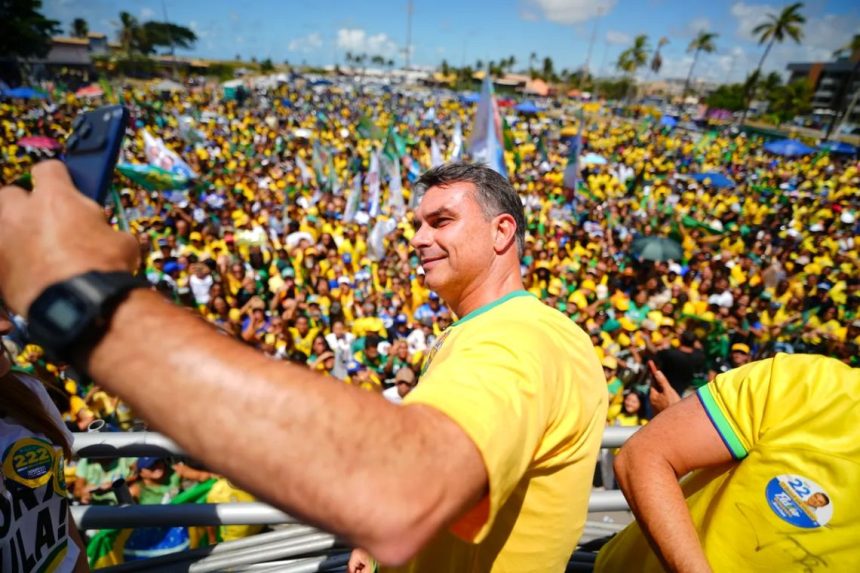
The final stretch of Brazil’s 2026 presidential campaign gained another chapter of intense political confrontation in Aracaju, Sergipe. During a campaign event in the state capital, Flávio Bolsonaro (PL) delivered a strongly critical speech against President Luiz Inácio Lula da Silva (PT), linking the current government to economic difficulties, increased public spending and the regulation of online betting.
- The “Tigrinho” controversy enters the campaign
- “Lulinha and Tigrinho”
- Sergipe’s oil wealth becomes another campaign theme
- The regional dimension of the presidential campaign
- A campaign increasingly defined by competing narratives
- The final week and the political battle for voters
- Aracaju as a snapshot of Brazil’s 2026 election
Speaking to supporters, Flávio argued that, in his assessment, the current government’s political project goes beyond keeping poor Brazilians in poverty. According to the candidate, its effect would be to “throw the poor into misery.”
The statement was presented as part of a broader comparison between the policies Flávio says he intends to pursue and those implemented under Lula’s administration.
But the most attention-grabbing moment of the event came through one of the campaign’s recurring themes: the expression “Father of Tigrinho,” a reference to the online betting market and the popular “Jogo do Tigrinho.”

In a deliberately ironic tone, Flávio displayed what he described as a “DNA test” linking Lula to Tigrinho. The gesture was presented as a political response to a legal dispute involving campaign material in which the president is associated with the online betting platform.
“I’m going to attach a DNA test to the lawsuit to find out who the father of Tigrinho is,” Flávio said, according to accounts of the speech.
He then displayed a card stating that Lula was “the father of Tigrinho.”
The episode quickly became one of the most symbolic moments of the Aracaju rally, combining political criticism, humor and a direct attack against Lula at a decisive point in the electoral calendar.
The “Tigrinho” controversy enters the campaign
The confrontation over online betting illustrates how complex public-policy issues can become powerful political symbols during an election.
Flávio has sought to associate Lula directly with the expansion and regulation of online betting in Brazil. The government, however, has taken measures to regulate and subsequently restrict parts of the sector, particularly amid concerns involving consumer protection, gambling addiction, household debt and the social consequences of betting platforms.
The history of betting regulation in Brazil is broader than the current presidential dispute.
Fixed-odds betting was initially authorized through legislation approved in 2018, during Michel Temer’s administration. The regulatory framework was subsequently expanded and structured under Lula’s government, particularly through legislation enacted in 2023.
As a result, the development of Brazil’s betting market cannot be attributed exclusively to a single administration. It involved different governments, legislative decisions by Congress and successive regulatory measures.
This distinction is relevant because electoral rhetoric frequently compresses a complex institutional history into a single political narrative.
For Flávio, “Father of Tigrinho” has become a campaign slogan used to criticize Lula’s government.
For the broader public debate, however, the issue involves questions of regulation, taxation, enforcement, consumer protection and the limits of state oversight over an expanding digital industry.
“Lulinha and Tigrinho”
Flávio intensified his criticism by declaring that Lula has “two sons” who, according to his political argument, have caused significant damage to Brazil: “Lulinha” and “Tigrinho.”
The statement was clearly used as political rhetoric rather than as a literal claim.
The strategy reflects the highly polarized environment surrounding the 2026 election, in which candidates seek to transform complicated economic and institutional issues into easily recognizable political symbols.
The “Tigrinho” reference allows Flávio to connect Lula with an issue that has generated growing public debate in Brazil.
At the same time, the historical development of online betting demonstrates why the subject requires a broader analysis. The legal framework was established through multiple legislative stages and different administrations, while the Lula government subsequently introduced additional regulations and restrictions.
The distinction between political rhetoric and documented institutional history is therefore essential when assessing the campaign’s competing narratives.
Sergipe’s oil wealth becomes another campaign theme
Beyond his attacks on Lula, Flávio used his visit to Sergipe to present an economic message centered on the state’s natural resources, particularly its oil potential.
The candidate argued that the wealth generated by oil production should be converted into investments benefiting the population.
According to Flávio, revenues associated with the sector could help finance improvements in healthcare, education and infrastructure.
“This wealth that God has given to the state of Sergipe, we are going to take it from the bottom of the sea and bring it to the people,” he said.
The proposal is based on the idea that the state’s natural-resource potential can become an instrument for regional economic development.
Flávio also criticized the management of Petrobras and argued that the state-owned oil company requires a different administrative approach.
In one of the strongest lines of his speech, he declared:
“If the PT manages the desert, in four years there will be no sand left.”
The statement reflects one of the central arguments of his campaign: presenting the PT’s management model as inefficient while proposing greater emphasis on economic performance, investment and management.
The challenge, however, extends beyond political slogans. Transforming oil revenues into improvements in public services requires fiscal planning, investment mechanisms, transparency, governance and effective oversight.
The regional dimension of the presidential campaign
The Aracaju event also carried an important regional dimension.
Flávio appeared alongside PL candidates running for congressional and Senate seats in Sergipe, including Senate candidates Rodrigo Valadares and Coronel Rocha, as well as congressional candidate Moana Valadares.
The event took place only one week before the election, giving the rally additional political significance.
Supporters wearing Brazil’s traditional green-and-yellow colors reinforced the visual identity associated with Flávio’s campaign and the broader political movement surrounding the Bolsonaro family.
The event also demonstrated how the presidential race is closely connected to state-level contests.
Presidential campaigns in Brazil frequently function as political platforms for congressional candidates, senators and regional party organizations. The final days of the campaign therefore involve not only the presidential dispute but also the struggle for representation in Congress.
A campaign increasingly defined by competing narratives
The rally in Aracaju illustrates one of the defining characteristics of Brazil’s 2026 presidential election: the contest is taking place not only through government programs and policy proposals, but also through slogans, symbols, political attacks and narratives designed to dominate the public debate.
“Father of Tigrinho” is a clear example.
For Flávio Bolsonaro, the expression serves as a political attack against Lula and a criticism of the government’s handling of online betting.
For Lula’s side, the issue is part of a broader dispute over campaign messaging and the political use of allegations involving online gambling.
The economic debate follows a similar pattern.
When Flávio says that Lula’s project is to “throw the poor into misery,” he is expressing a political assessment of the government’s economic policies. Whether that characterization accurately reflects economic conditions requires examination of indicators such as inflation, employment, income, purchasing power, public spending and fiscal accounts.
This distinction becomes particularly important in the final days before voting.
The final week and the political battle for voters
With the first round approaching, every major campaign event assumes additional importance.
The objective is no longer simply to present policies. Candidates are also seeking to consolidate political identities, reinforce their supporters and establish a clear contrast with their opponents.
In Aracaju, Flávio Bolsonaro focused on three central themes: direct confrontation with Lula, criticism of online betting and the promise to transform Sergipe’s oil wealth into broader economic and social investment.
The “DNA test” involving Tigrinho added humor and provocation to an already highly polarized presidential campaign.
At the same time, the betting debate demonstrates how complex regulatory questions can be transformed into powerful campaign slogans.
Brazil’s betting industry, however, has a much longer institutional history involving Congress, previous administrations, regulatory decisions and subsequent restrictions.
The same applies to the debate over oil.
The promise to transform natural-resource wealth into investments in healthcare, education and infrastructure raises practical questions about how those resources would be managed, how revenues would be distributed and which mechanisms would guarantee transparency and accountability.
These questions become increasingly important as voters approach election day.
Aracaju as a snapshot of Brazil’s 2026 election
Flávio Bolsonaro’s appearance in Aracaju was more than another campaign rally. It provided a snapshot of the political strategy being employed during the final stage of the presidential race.
The candidate combined criticism of Lula, economic arguments, regional development proposals and highly recognizable political symbolism.
The “Father of Tigrinho” episode demonstrated the importance of political communication in the current campaign, where a single phrase can become a national talking point.
Sergipe, meanwhile, served as a backdrop for a broader economic argument involving oil, investment and regional development.
The central question is no longer simply which slogans dominate the final days of the campaign. It is how voters evaluate the competing proposals, the governments’ records, the available economic data and the feasibility of the commitments being presented.
As Brazil enters the final stage of the 2026 presidential election, Aracaju illustrates the intensity of the political confrontation.
The campaign is increasingly centered on competing visions of Brazil’s economy, public administration, natural resources and social policies.
The final decision, however, will ultimately depend on voters assessing those competing narratives against the documented record, policy proposals and economic realities facing the country.