


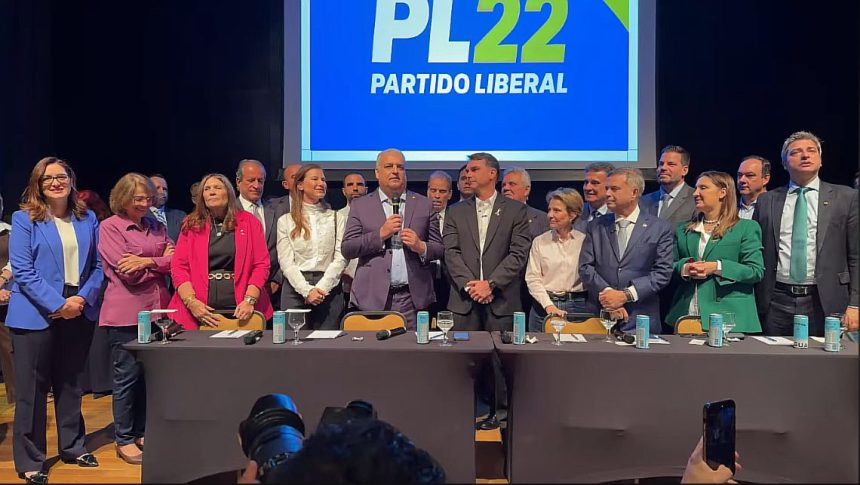
The selection of Congressman Alfredo Gaspar as vice-presidential nominee reinforces the Liberal Party’s emphasis on public security, institutional governance, and anti-corruption policies while shaping its strategic positioning for Brazil’s 2026 presidential election.
Brazil’s political landscape entered a new phase as Senator Flávio Bolsonaro (PL-RJ) officially announced Congressman Alfredo Gaspar (PL-AL) as his vice-presidential running mate for the 2026 presidential election. The decision establishes an all-Liberal Party ticket and signals a strategic effort to reinforce the party’s political identity while broadening its appeal across different sectors of the Brazilian electorate.
By selecting Alfredo Gaspar, Flávio Bolsonaro brings to the campaign a figure widely recognized for his background in law enforcement, public prosecution, and public administration. The announcement also demonstrates the Liberal Party’s intention to strengthen its message around public safety, institutional stability, and government efficiency—issues expected to play a central role throughout the 2026 electoral campaign.
Who Is Alfredo Gaspar?
Alfredo Gaspar de Mendonça Neto, born in Maceió, Alagoas, built much of his professional career as a public prosecutor, becoming one of the most prominent legal figures in his home state. Throughout his years in the Public Prosecutor’s Office, he participated in major criminal investigations involving organized crime, corruption, homicide cases, and complex criminal organizations.
He later served as Secretary of Public Security for the State of Alagoas, where he coordinated integrated policing strategies and public security initiatives aimed at reducing crime and improving cooperation among law enforcement agencies. His tenure earned him national recognition as a public administrator focused on institutional strengthening and crime prevention.

In 2022, Alfredo Gaspar was elected to Brazil’s Chamber of Deputies as a member of the Liberal Party. Since taking office, he has concentrated much of his legislative work on public security, criminal justice reform, law enforcement support, judicial matters, and initiatives designed to combat organized crime.
His professional trajectory has positioned him as one of the Liberal Party’s most experienced figures in legal and security affairs, making him a natural choice to complement the presidential ticket.
A Strategic Political Partnership
The composition of the ticket reflects a carefully designed political strategy.
While Flávio Bolsonaro represents political continuity and maintains strong support among conservative and center-right voters, Alfredo Gaspar contributes extensive administrative experience and a technical background developed over decades within Brazil’s justice system.
The partnership also strengthens the party’s geographic representation by combining political leadership from Rio de Janeiro and Alagoas, expanding the campaign’s national reach across different regions of Brazil.
Political observers also note that Gaspar’s institutional profile may enhance the campaign’s dialogue with legal professionals, members of the judiciary, law enforcement agencies, business leaders, and voters seeking candidates with practical administrative experience.
Public Security at the Core of the Campaign
The announcement reinforces one of the Liberal Party’s longstanding political priorities: public security.
Crime prevention, organized crime, policing, prison reform, and judicial efficiency remain among the issues consistently identified by Brazilian voters as major national concerns.
Alfredo Gaspar’s professional experience provides the campaign with credibility on these matters. His background is expected to support the development of policy proposals involving police modernization, intelligence operations, institutional cooperation among security agencies, stronger action against organized crime, and enhanced support for law enforcement professionals.
These themes are likely to become central pillars of the campaign’s public policy agenda.
Political and Electoral Implications
The announcement also reshapes Brazil’s evolving presidential race.
By formally defining its presidential ticket early in the electoral cycle, the Liberal Party gains additional time to strengthen alliances with governors, members of Congress, mayors, local leaders, and civil society organizations throughout the country.
From a strategic perspective, the ticket combines political leadership with institutional expertise—an approach frequently used by presidential campaigns seeking to project stability, competence, and administrative preparedness.
Alfredo Gaspar’s inclusion may also broaden the campaign’s appeal among voters who value candidates with professional careers outside traditional party politics, particularly those with experience in public administration and the justice system.
Challenges Ahead
Despite the political significance of the announcement, the road to Brazil’s presidency remains highly competitive.
The 2026 campaign is expected to focus on economic growth, fiscal responsibility, employment, tax reform, public security, healthcare, education, technological innovation, and digital transformation.
To remain competitive, the Liberal Party’s ticket will need to present comprehensive policy proposals capable of addressing Brazil’s structural challenges while building broad political alliances and maintaining dialogue across diverse sectors of society.
The effectiveness of this partnership will ultimately depend not only on electoral messaging but also on the ability to articulate a coherent governing agenda that balances economic development, institutional stability, and social priorities.
Final Analysis
Flávio Bolsonaro’s decision to select Alfredo Gaspar as his vice-presidential running mate represents one of the Liberal Party’s most significant strategic moves ahead of Brazil’s 2026 presidential election.
The ticket combines political leadership, legislative experience, legal expertise, and a strong background in public security—attributes that align closely with the party’s long-standing political platform.
As Brazil moves closer to the presidential election, this partnership is expected to play an increasingly important role in shaping national political debate. Whether the strategy succeeds will depend on the campaign’s ability to transform these institutional credentials into a broader national agenda capable of addressing the economic, social, and governance challenges facing the country.