

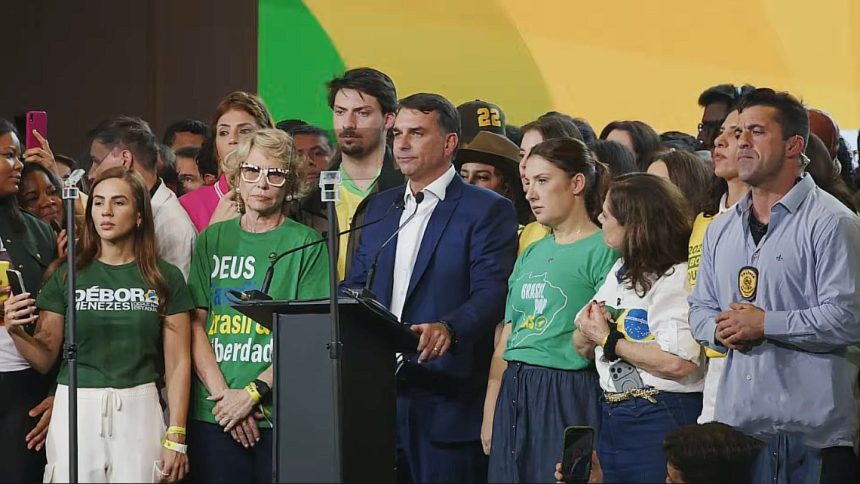
São Paulo, Brazil — The State and National Convention of Brazil’s Liberal Party (PL), held on Saturday morning, marked the official beginning of a new phase in the country’s presidential race. In a carefully orchestrated event designed to demonstrate party unity, organizational strength, and political momentum, the PL formally confirmed Senator Flávio Bolsonaro as its presidential nominee, bringing together prominent Brazilian leaders and international guests in a convention that extended well beyond its procedural purpose.
- A Convention with National and International Significance
- The Political Meaning of the Nomination
- Valdemar Costa Neto’s Strategic Role
- The Importance of Tarcísio de Freitas
- Ricardo Nunes and Coalition Building
- Javier Milei and the Regional Political Context
- The Challenges Ahead
- Brazil’s Political Landscape
- Final Considerations
Rather than serving solely as the formal ratification of a candidacy, the convention highlighted the Liberal Party’s broader strategy to consolidate Brazil’s conservative political movement, reinforce its institutional narrative, and position Flávio Bolsonaro as the standard-bearer for a political project that has shaped the country’s center-right landscape over the past decade.
From the opening moments of the ceremony, symbolism played a central role. The first individual invited to the stage was Rogéria Nantes Bolsonaro, Flávio Bolsonaro’s mother and the first wife of former President Jair Bolsonaro. Her appearance carried both political and personal significance, underscoring the importance of family identity that has long been associated with the Bolsonaro political movement.
She was followed by Valdemar Costa Neto, President of the Liberal Party and one of the principal architects behind the party’s recent expansion into one of Brazil’s largest political organizations. His presence reinforced institutional support for the newly nominated candidate and demonstrated the party leadership’s commitment to the upcoming presidential campaign.

A Convention with National and International Significance
The event assembled an influential group of political leaders representing both domestic and international conservative movements.
Among the most notable attendees was Argentine President Javier Milei, whose participation elevated the convention’s international profile. Milei has emerged as one of Latin America’s most recognizable conservative and libertarian leaders, and his attendance symbolized growing political dialogue among like-minded governments and movements throughout the region.
His presence was widely interpreted as an indication of strengthening cooperation between leaders who advocate for free-market economic reforms, fiscal responsibility, reduced government intervention, expanded private-sector participation, and institutional modernization.
Domestically, the convention also welcomed São Paulo Governor Tarcísio de Freitas (Republicanos) and São Paulo Mayor Ricardo Nunes (MDB).
The participation of these prominent officials suggested that the Liberal Party seeks to broaden its political alliances beyond its own membership, fostering cooperation among center-right parties and reinforcing its position within Brazil’s evolving political landscape.
The Political Meaning of the Nomination
Although widely anticipated, Flávio Bolsonaro’s official nomination represents an important milestone in the reorganization of Brazil’s conservative political forces.
As a sitting senator, Flávio Bolsonaro enters the presidential race with years of legislative experience and the considerable political influence associated with the Bolsonaro family, which remains one of the country’s most recognizable political brands.
His candidacy is likely to be evaluated from two complementary perspectives.
The first concerns the continuation of a political platform emphasizing public security, economic liberalization, tax simplification, reduced bureaucracy, support for agribusiness, institutional stability, and conservative social values.
The second involves the challenge of establishing an independent political identity capable of appealing to a broader national electorate while presenting policy proposals that extend beyond the legacy of his family’s political trajectory.
Valdemar Costa Neto’s Strategic Role
Behind the scenes, few figures hold as much influence within the Liberal Party as Valdemar Costa Neto.
Under his leadership, the PL has significantly expanded its representation in Brazil’s National Congress, state governments, and municipal administrations, becoming one of the country’s most influential political organizations.
His appearance at the convention reinforced the message of party unity and demonstrated that Flávio Bolsonaro’s presidential campaign begins with the full institutional backing of the party’s national leadership.
Such support will be particularly significant as the campaign advances through coalition-building, regional negotiations, campaign financing, and electoral coordination.
The Importance of Tarcísio de Freitas
Governor Tarcísio de Freitas’ participation also attracted considerable attention.
Widely regarded as one of the leading figures of Brazil’s emerging center-right leadership, Tarcísio has built a political reputation centered on infrastructure development, public administration, fiscal management, and investment promotion.
His presence at the convention was interpreted as a demonstration of institutional alignment with the broader political agenda presented by the Liberal Party, while also highlighting his growing influence within Brazil’s national political landscape.
Ricardo Nunes and Coalition Building
The attendance of São Paulo Mayor Ricardo Nunes further illustrated the Liberal Party’s efforts to engage political actors beyond its own ranks.
As a member of the Brazilian Democratic Movement (MDB), Nunes’ participation reflected ongoing dialogue among parties that may seek future cooperation based on shared priorities involving economic growth, public administration, infrastructure, and governance.
Such interactions underscore the increasingly pragmatic nature of Brazilian coalition politics ahead of national elections.
Javier Milei and the Regional Political Context
President Javier Milei’s participation also introduced an important geopolitical dimension to the convention.
Latin America has experienced significant political realignment in recent years, with governments across the region alternating between different ideological orientations.
Within this broader context, the growing interaction between Brazilian and Argentine conservative leaders reflects efforts to strengthen regional cooperation in areas such as economic policy, international trade, institutional reform, energy security, and investment.
Although each country operates within its own constitutional and political framework, the convention demonstrated an increasing willingness among conservative governments and political movements to develop stronger channels of international dialogue.
The Challenges Ahead
With the nomination officially confirmed, the campaign now enters a new phase centered on policy development, coalition-building, public engagement, and electoral strategy.
Among the principal challenges facing the campaign are:
- Expanding electoral support beyond its traditional base;
- Building consensus among moderate and independent voters;
- Presenting comprehensive economic reform proposals;
- Strengthening public security policies;
- Advancing administrative modernization;
- Maintaining fiscal responsibility;
- Increasing Brazil’s international competitiveness;
- Promoting technological innovation;
- Encouraging regional development; and
- Reinforcing democratic institutions and political stability.
At the same time, the campaign will unfold in an increasingly competitive political environment where digital communication, grassroots mobilization, coalition management, and legislative support are expected to play decisive roles.
Brazil’s Political Landscape
The convention also reflects a broader transformation in contemporary democratic politics.
Political conventions have evolved far beyond their traditional procedural function. They now serve as major communication platforms through which parties demonstrate organizational capacity, political influence, leadership cohesion, and strategic direction to voters, institutions, and financial markets alike.
In this context, the Liberal Party sought to present itself as a unified political organization with national reach and growing international visibility.
The simultaneous presence of influential Brazilian and foreign leaders reinforced this objective, projecting an image of political cohesion and organizational strength as the presidential campaign officially begins.
Final Considerations
The State and National Convention of Brazil’s Liberal Party represents a significant milestone in the country’s electoral calendar by officially nominating Senator Flávio Bolsonaro as the party’s presidential candidate.
Beyond fulfilling its legal and procedural role, the convention was designed to project institutional unity, reinforce the party’s strategic vision, and demonstrate its ability to cultivate both domestic and international political partnerships.
With the participation of Rogéria Nantes Bolsonaro, Valdemar Costa Neto, Argentine President Javier Milei, Governor Tarcísio de Freitas, and Mayor Ricardo Nunes, the event presented a carefully coordinated image of political organization that is likely to influence the coming months of Brazil’s presidential campaign.
As the electoral process moves forward, political platforms, public debate, coalition-building, and policy proposals will increasingly define the national conversation. Ultimately, it will be Brazilian voters who determine which vision for the country’s future will prevail through the democratic process.
In today’s increasingly complex political environment, conventions such as this continue to play an essential role within representative democracy—not merely by formalizing candidacies, but by articulating political strategies, consolidating leadership, and presenting competing visions for the nation’s future.