

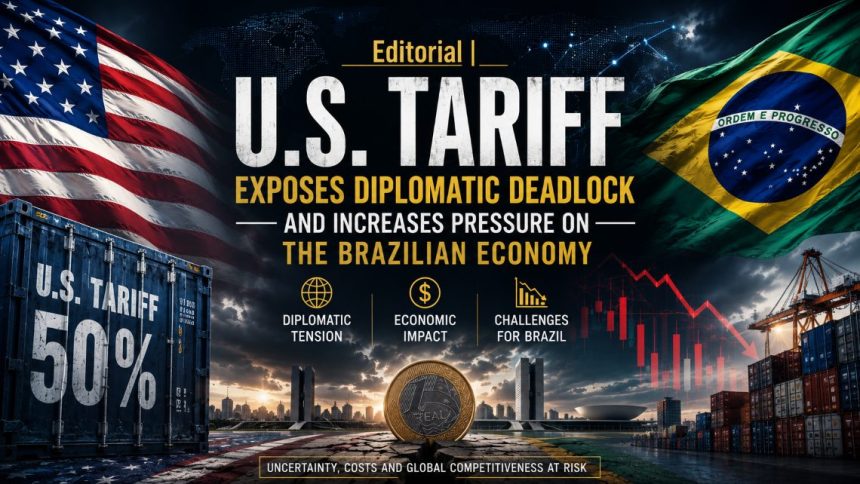
Relations between Brazil and the United States have once again moved to the forefront of the international agenda following Washington’s decision to impose a 25% tariff on selected Brazilian exports. The measure, announced after an investigation conducted by the Office of the United States Trade Representative (USTR), marks a new chapter in bilateral trade tensions and carries implications that extend well beyond the economic sphere.
The issue gained even greater political significance after U.S. Secretary of State Marco Rubio publicly attributed responsibility for the failed negotiations directly to Brazilian President Luiz Inácio Lula da Silva. In statements released through social media, Rubio argued that the Brazilian government had not negotiated in “good faith” and claimed that President Lula had placed his own political interests and personal priorities ahead of an agreement that could have benefited Brazil’s economy.
Regardless of the political tone adopted by U.S. officials, these remarks illustrate that the dispute has evolved from a commercial disagreement into a broader diplomatic and geopolitical confrontation.
Understanding the U.S. Decision
The newly imposed tariffs followed an investigation carried out by the Office of the United States Trade Representative (USTR), the federal agency responsible for shaping and enforcing U.S. trade policy. The investigation examined several issues that Washington considers significant sources of bilateral trade friction, including:

- Brazil’s instant payment system, Pix;
- Policies affecting ethanol imports and market access;
- Regulations governing international digital platforms;
- Regulatory barriers perceived as unfavorable to American companies;
- Concerns regarding legal certainty and Brazil’s overall business environment.
According to the U.S. government, these issues have created obstacles to fair bilateral trade and justified the implementation of corrective measures under American trade legislation.
The Brazilian government, however, maintains a different position. Brasília argues that its public policies are legitimate expressions of national sovereignty, designed to protect domestic interests while remaining consistent with international trade obligations.
When Politics Overtakes Economics
Although tariffs are common instruments in international trade disputes, what distinguishes this episode is the highly personalized political narrative surrounding it.
By explicitly placing responsibility on President Lula, Marco Rubio significantly elevated the diplomatic stakes.
Traditionally, trade disagreements are managed through negotiations involving trade representatives, economic ministries and technical specialists. When the U.S. Secretary of State—the country’s highest-ranking diplomatic official—takes a leading role in the public debate, the dispute inevitably reflects the broader political relationship between the two governments.
This development suggests that Washington may be using trade policy not only as an economic instrument but also as a strategic tool to increase diplomatic pressure on Brasília.
Potential Economic Consequences for Brazil
The newly imposed tariffs are expected to affect different sectors of the Brazilian economy in varying degrees.
Potential consequences include:

- Reduced competitiveness of Brazilian exports in the U.S. market;
- Loss of market share to competing international suppliers;
- Higher operating costs for exporters;
- Delays in investment decisions;
- Increased exchange-rate volatility should tensions persist;
- Employment pressures in export-oriented industries.
The United States remains one of Brazil’s largest trading partners, importing a significant share of Brazilian manufactured goods, industrial products, machinery, aerospace components, steel and agribusiness commodities.
A prolonged deterioration in bilateral relations could therefore have meaningful consequences for exporters, industrial production and long-term investment.
The Diplomatic Challenge
International trade specialists frequently emphasize that trade disputes rarely produce clear winners.
When two major economic partners enter a cycle of retaliatory measures, both sides ultimately absorb economic, political and diplomatic costs.
Against this backdrop, the most constructive path forward remains institutional dialogue.
History demonstrates that periods of tension between Brazil and the United States have often been followed by renewed negotiations, particularly when mutual economic interests outweighed political disagreements.
The continuation of formal discussions between trade officials will likely be essential to preventing a broader escalation of tariff measures.
Brazil’s Strategic Response
For the Brazilian government, the challenge lies in balancing three strategic priorities simultaneously:
- Preserving national sovereignty over domestic public policies;
- Protecting the interests of Brazilian exporters and productive sectors;
- Maintaining open diplomatic channels with Washington.
Achieving these objectives will require close coordination among the Ministry of Foreign Affairs, the Ministry of Development, Industry, Trade and Services, the Ministry of Finance and representatives from Brazil’s private sector.
Brazil may also consider mechanisms available under the World Trade Organization (WTO) should it determine that the U.S. measures exceed internationally accepted trade rules.
A Global Environment That Demands Pragmatism
The current dispute highlights how international trade and geopolitics have become increasingly interconnected.
In an environment characterized by technological competition, supply-chain realignment, strategic industrial policies and growing rivalry among major powers, trade decisions are no longer driven solely by economics. They have become instruments of diplomacy, national security and geopolitical influence.
For Brazil, maintaining access to international markets remains a strategic priority.
Likewise, the United States continues to represent one of Brazil’s most important economic partners, regardless of the political differences between their respective administrations.
Within this context, constructive negotiation offers a more sustainable path than prolonged diplomatic confrontation.
Final Considerations
Marco Rubio’s statements, combined with Washington’s decision to impose a 25% tariff on selected Brazilian products, represent far more than a conventional trade disagreement. They symbolize a period of increasing diplomatic friction between two of the Western Hemisphere’s largest economies.
While the political rhetoric surrounding the dispute has intensified international attention, the ultimate resolution will depend less on public statements and more on both governments’ willingness to restore effective diplomatic dialogue.
The coming months will determine whether this dispute remains confined to targeted tariff measures or develops into a broader commercial conflict with deeper economic and geopolitical implications.
For businesses, investors and exporters, careful monitoring of these developments will be essential, as the outcome may significantly influence investment decisions, international trade flows, industrial competitiveness and Brazil’s broader economic outlook.
In an increasingly complex global economy, diplomacy, regulatory predictability and constructive engagement remain the most effective instruments for preserving long-term commercial partnerships and safeguarding national interests.