

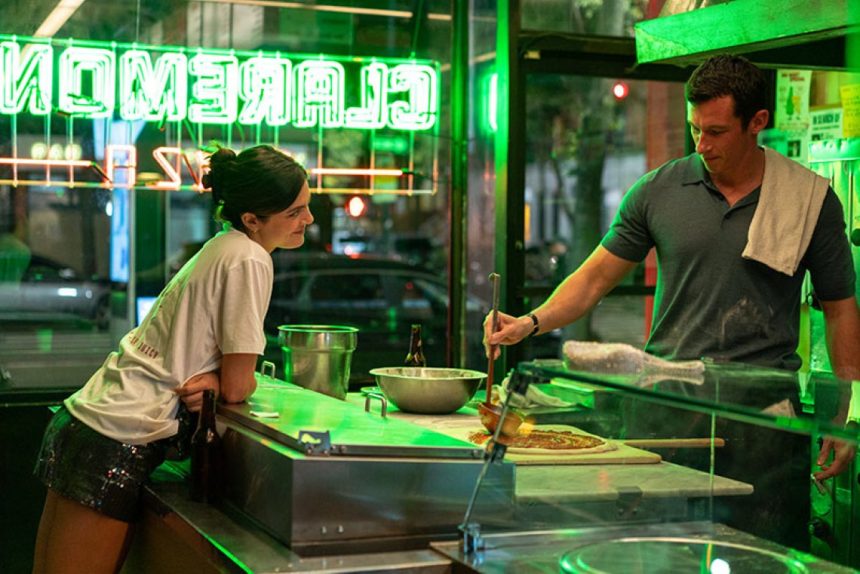


Some films use romantic comedy merely as a backdrop for a predictable encounter between two charismatic leads. Others decide to twist that formula until it becomes almost unrecognizable — and that’s exactly the bet Universal Pictures made when it announced “One Night Only,” a production set to hit theaters in August 2026 carrying an uncomfortable question: what would happen if love — or at least desire — could only exist for a few hours a year?
The answer, according to the first trailer released by the studio, is a version of New York that seems to have come straight out of a conservative nightmare. In this slightly futuristic take on the city, any intimacy outside of marriage is against the law. There is, however, one escape valve: the so-called “Free Night,” a twelve-hour window — from 7 p.m. to 7 a.m. the following morning — during which the state allows, once a year, single people to live however they want without consequence.
It’s within this night of exception that the story finds its two leads. Allie, played by Monica Barbaro, and Owen, played by Callum Turner, cross paths after both are dumped by their respective partners at almost the same time. He’s still trying to process the pain of a recent breakup; she remains the kind of character who, despite countless disappointments, still believes something real is out there waiting to be found. The chemistry between the two is immediate — the rare kind, even by movie standards. The problem is that the script doesn’t make things easy for either of them.
Throughout the night, a string of near-misses, coincidences, and paths that cross without quite meeting keeps pulling Allie and Owen apart across the streets of Manhattan, which are packed with an euphoric crowd making the most of the year’s only chance at freedom. What should have been a simple love-at-first-sight story turns into a race against the clock — literally, since the old rules kick back in at dawn. It’s in that gap, between the collective euphoria and each character’s personal search, that the film seems to be asking its most interesting question: is what the two are really looking for as physical as the law allows, or is it something closer than they think?

The Inevitable Comparison to “The Purge”
It’s no surprise the premise has already drawn comparisons to “The Purge” franchise. The narrative logic is similar: a dystopian society that suspends its own rules for a limited period of time. But where the horror franchise unleashes violence, “One Night Only” uses the same device for a different purpose — swapping bloody chaos for emotional chaos, blending social satire with romance in a way that seems just as eager to provoke laughs as it is to prompt reflection on how we regulate — or try to regulate — modern relationships.
Who’s Behind and In Front of the Camera
The film is directed by Will Gluck, a name that moves comfortably through the romantic comedy world, with a screenplay co-written alongside Travis Braun. Production and distribution are handled by Universal Pictures, which has been putting significant weight behind the film’s marketing campaign.
At the center of the story are Monica Barbaro, known for “Top Gun: Maverick” and “A Complete Unknown,” and Callum Turner, seen in “Masters of the Air” and the “Fantastic Beasts” franchise. Rounding out the cast is a supporting lineup notable for its range: Maya Hawke, Julia Fox, LeVar Burton, Michelle Hurd, King Princess, Ben Marshall, Ziwe, and Molly Ringwald.
When to Watch It
In the United States, “One Night Only” opens in theaters on August 7, 2026. In Brazil, the confirmed release date is August 27, 2026 — a gap that, ironically, is far longer than the single night of freedom the film is named after.
What to Expect
It’s hard not to see “One Night Only” as one of the more intriguing bets among 2026’s crop of romantic comedies. It’s a film that seems willing to laugh at itself and at the society it portrays, without abandoning what makes the genre work in the first place: two people, one night, and the nagging suspicion that what they’re looking for was never just physical. What remains to be seen is whether, caught between satire and romance, the film manages to balance both without losing its heart along the way.