

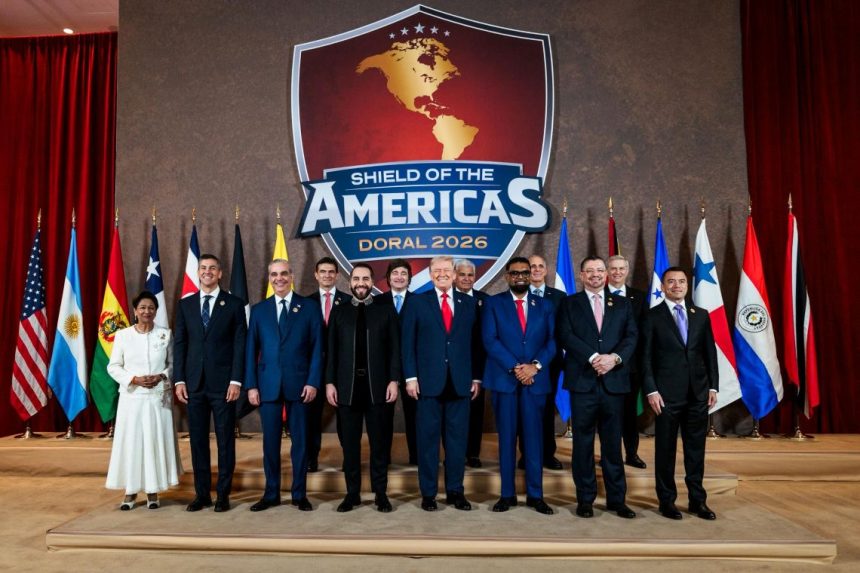
The recent Shield of the Americas Summit, led by US President Donald J. Trump, brought together a number of Latin American and Caribbean leaders on American soil to discuss an issue that has challenged governments and societies on the continent for decades: regional security. More than a diplomatic gathering, the meeting revealed a political movement that could redefine strategic relations in the Americas.
Held in Miami, the summit was presented as a new mechanism for cooperation to tackle transnational organized crime, drug cartels, human trafficking, and the migration crises that are putting pressure on borders and institutional systems across the hemisphere. In an increasingly complex international scenario, the initiative also carries a clear geopolitical objective: to strengthen alliances on the continent and reaffirm the United States’ leadership in the regional security architecture.
The presence of leaders such as Javier Milei from Argentina, Nayib Bukele from El Salvador, Daniel Noboa from Ecuador, Luis Abinader from the Dominican Republic, and Santiago Peña from Paraguay demonstrates that part of Latin America is willing to deepen cooperation with Washington on issues of security and institutional stability. Representatives from Costa Rica, Panama, Guyana, Trinidad and Tobago, Honduras, and Bolivia also participated.
However, the meeting also highlighted the political divisions that run through the region. The absence of regional powers such as Brazil, Mexico, and Colombia was widely noted by analysts and diplomats. These countries have historically played a central role in hemispheric integration initiatives, and their absence raises questions about the ability of a new coalition to consolidate without the full participation of the largest Latin American economies.

Even so, the summit reflects a moment of strategic reorganization in the Americas. The growing economic and political presence of external powers—especially China, in addition to diplomatic moves by Russia and Iran in the region—has made the continent a more obvious arena for geopolitical competition. In this context, the proposal for the so-called “Shield of the Americas” emerges as an attempt to consolidate a cooperative bloc among governments aligned with a more integrated security agenda.
The initiative is still in its early stages, and its concrete impact will depend on practical agreements, real intelligence sharing, and coordination between national security forces. The history of inter-American relations shows that large regional projects often face political challenges, changes in government, and divergent interests.
Even so, the Shield of the Americas Summit reveals an essential point: the security of the continent is no longer an isolated issue for each country and now requires collective responses. In a hemisphere marked by intense migratory flows, increasingly sophisticated criminal networks, and growing geopolitical disputes, regional cooperation tends to become not only desirable—but inevitable.
It is still too early to say whether this new alliance will be able to turn rhetoric into concrete results. What can already be said is that the meeting led by Donald J. Trump opens a new chapter in the diplomacy of the Americas—a chapter that could influence the political and strategic balance of the continent in the coming years.