

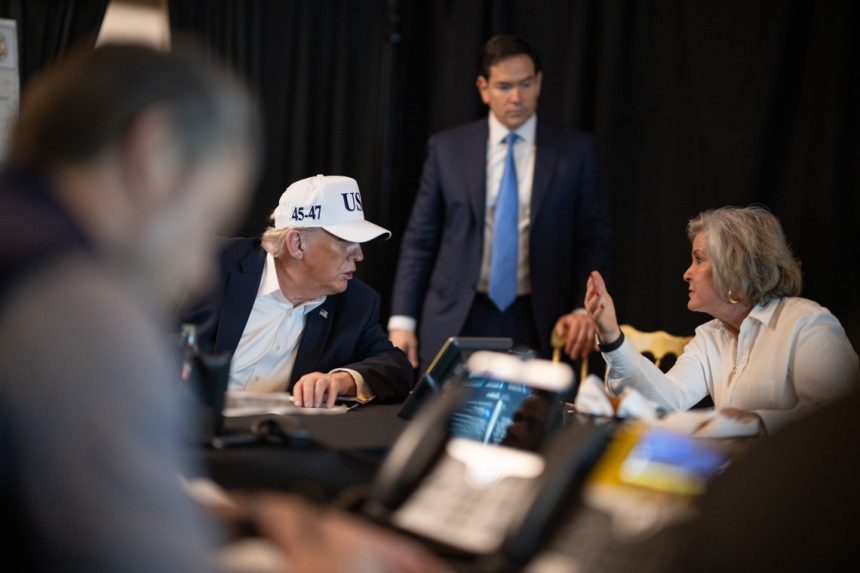
In the early hours of February 28, 2026, images released by the White House showed President Donald J. Trump alongside national security advisors monitoring, in real time, the unfolding of the American military offensive against Iran. The operation, officially named Operation Epic Fury, marks one of the most significant actions by the United States in the Middle East in recent years—and ushers in a new chapter of geopolitical uncertainty.
The attack, carried out in coordination with Israel, targeted strategic Iranian structures associated with military programs and defense systems. According to the U.S. administration, the goal is to contain immediate threats to regional security and prevent advances considered critical in the field of armaments. Tehran reacted quickly, classifying the offensive as direct aggression and promising retaliation.
A divided world
The international reaction was immediate and reveals an increasingly polarized scenario. The European Union called for moderation and the opening of diplomatic channels, with France, Germany, and the United Kingdom advocating a negotiated solution. Russia, on the other hand, condemned the operation, classifying it as a unilateral act that could compromise global stability. China, for its part, expressed concern about Iranian sovereignty and warned of the risks of a prolonged escalation.

In the Middle East, the mood is one of apprehension. Gulf countries, even those historically critical of the Iranian government, fear that the conflict will spill over their borders and directly affect their internal security and economic interests.
The immediate impact on markets
While the diplomatic response was cautious, markets reacted quickly. International stock exchanges experienced volatility in the first few hours after the attacks. Investors migrated to assets considered safe, while oil prices skyrocketed amid fears of supply disruptions.
The main concern is the Strait of Hormuz, a strategic corridor through which about one-fifth of the oil traded on the planet passes. Any threat of blockade or attack on the region is enough to put pressure on prices and raise risk premiums in maritime transport.
Analysts are already talking about the possibility of oil returning to US$100 per barrel if tensions persist. For economies highly dependent on energy imports, the impact could come in the form of inflation, increased industrial costs, and slower growth.
Energy, diplomacy, and systemic risk
More than just a one-off military operation, Epic Fury exposes the fragility of the global energy balance. Interconnected supply chains make regional conflict a global problem. Asian countries, major consumers of Middle Eastern oil, are watching developments with concern.
Behind the scenes, diplomatic efforts are attempting to contain the escalation. Multilateral organizations are discussing emergency meetings and advocating for an immediate ceasefire. The central question is whether there will be political space for negotiation or whether the dynamics of successive retaliations will lead to a broader conflict.
Leadership under scrutiny
By releasing images of the president monitoring the operation, the White House signals control and direct leadership at a critical moment. But the decision also reignites internal debates in the United States about the limits of executive power in large-scale military actions.
The fact is that Operation Epic Fury has already gone beyond the tactical field. It redefines alliances, puts pressure on markets, raises strategic risks, and puts the international system to yet another test of resilience.
In an interconnected world, each missile launched carries not only military impact, but economic, diplomatic, and political repercussions that span continents. The outcome is still uncertain—but the global warning signal has already been triggered.
Editorial+
Operation Epic Fury and the new breaking point in global balance
The dawn that marked the beginning of Operation Epic Fury was not just another chapter in the long history of tensions in the Middle East. It was a watershed moment. By directly overseeing military action against Iran, President Donald J. Trump placed the United States at the center of an escalation that quickly went from being regional to taking on global proportions.
Coordinated with Israel, the offensive targeted strategic Iranian structures. Washington justified the action as preventive and necessary to neutralize imminent threats. Tehran responded with strong rhetoric and promises of retaliation, while missiles and security alerts heightened tensions across the Gulf.
But the impact of Epic Fury is not limited to the battlefield.
Geopolitics: the world divided once again
The international reaction exposed an increasingly fragmented global order. The European Union advocated immediate de-escalation and a diplomatic solution, seeking to preserve the fragile regional balance. France, Germany, and the United Kingdom called for dialogue, fearing that the conflict would compromise not only security but also strategic agreements built up over many years.
Russia, on the other hand, strongly condemned the attacks, classifying them as unilateral aggression. Moscow sees the offensive as an expansion of American military influence in an area where it also has strategic interests. China adopted a similar tone, calling for respect for Iranian sovereignty and warning of systemic risks to international stability.
In the Middle East, Washington’s traditional allies have adopted a cautious stance. Gulf countries, although historically distrustful of Tehran, know that a prolonged war could affect their own territories and compromise their economies.
The emerging scenario is one of a new dividing line between power blocs—an environment reminiscent of the disputes over influence typical of a multipolar order in consolidation.
Markets on alert: volatility and flight to safe assets
While diplomacy moves at a calculated pace, markets react in seconds. The mere confirmation of the attacks was enough to trigger volatility in major global stock exchanges. Investors migrated to assets considered safe havens, such as gold and US Treasury bonds, while stocks and cryptocurrencies suffered sharp fluctuations.
The central fear is clear: geopolitical instability increases systemic risk. Conflicts in the Middle East historically impact logistics chains, marine insurance, and transportation costs. In a global environment still sensitive to inflationary shocks, any additional disruption could put pressure on fragile economies.
Asian economies, which are highly dependent on energy imports, are watching every move with heightened attention. For them, war is not just a diplomatic issue—it is a direct threat to growth.
Energy at the epicenter of the crisis
The most sensitive point of the conflict is in the Strait of Hormuz, a strategic corridor through which about 20% of the world’s oil transits. Even without an effective blockade, the risk of disruption is already raising insurance premiums and putting pressure on futures contracts.
Analysts project that the price per barrel could return to triple digits if there is an escalation or attacks on energy infrastructure. For net energy importers, this means higher inflation, pressure on monetary policies, and a possible economic slowdown.
In addition to oil, the liquefied natural gas market also enters the equation. Any prolonged instability compromises shipping schedules and long-term contracts, affecting Europe and Asia simultaneously.
The crisis reveals, once again, the structural vulnerability of an energy system still heavily concentrated in geopolitically unstable regions.
Diplomacy under pressure
Multilateral organizations discuss emergency meetings while discreet mediation attempts gain momentum behind the scenes. Countries with open channels to both Washington and Tehran seek to avoid a sequence of retaliations that could lead to an escalating conflict.
The question that arises is whether there will be political space for strategic retreat. Recent history shows that direct confrontations between powers and regional actors tend to generate cycles of action and reaction that are difficult to contain.28
A conflict beyond the military arena
Operation Epic Fury marks a moment of strategic redefinition. It is not just an air strike or a tactical calculation. It is a move that repositions alliances, puts pressure on global markets, and exposes the fragility of the international energy balance.
By making public the image of direct leadership in monitoring the offensive, the White House reinforces the narrative of firmness. However, the political and economic cost of an escalation remains unpredictable.
In an interdependent world, every military decision reverberates in stock markets, supply chains, and diplomatic negotiating tables. The question that remains is not only who will win in the strategic arena, but what will be the global price of yet another crisis in a region that remains the nerve center of energy geopolitics.
The outcome is still open. But the impact is already global.