

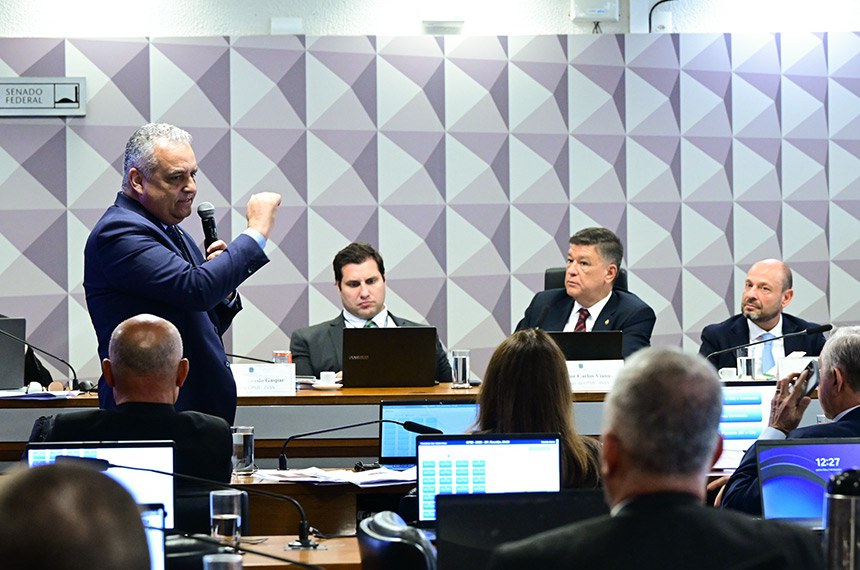

The rapporteur for the
INSS CPMI
, Representative Alfredo Gaspar (União-AL), stated that the deficit caused by irregularities in payroll loans to retirees and pensioners may be even greater than that of associative discounts on benefits. The statement was made on Thursday (5) during testimony by INSS President Gilberto Waller to the commission.
“In membership discounts, the loss was R$ 6 billion, R$ 7 billion. Here [in payroll loans], we don’t even know how to measure the size of the loss because there is no one to oversee it. We have to have clear rules for the financial system,” said Gaspar, stating that the INSS does not have enough staff to oversee all contracts and that oversight is done by sampling.
According to the rapporteur, it is absurd that banks with reports of irregularities in contracts continue to operate with the INSS. For Gaspar, the irregularities even involve banks considered “clean,” and the CPMI needs to propose changes to increase the oversight of these loans.

Waller assured that since last year, the INSS has created rules to make the process of authorizing and monitoring payroll loans more rigorous. He took over the institute in April 2025, after news of fraud in associative discounts.
The manager was summoned to testify in two requests, one of which (REQ 395/2025) was submitted by the committee chair, Senator Carlos Viana (Podemos-MG). In the request, the senator stated that the testimony could clarify the measures adopted since the witness took office and identify the administrative responsibilities of the current administration.
Focus
The work of the CPMI, which began by focusing on the deduction of association and union dues from social security benefits, has now shifted its focus to payroll loans.
Among the irregularities cited by lawmakers are loans to children and deceased individuals, as well as abusive charges for unforeseen interest and services (such as benefit clubs) in amounts approaching 20% of the payroll loan value.
“Payroll loans are necessary to supplement retirement income, but without people being cheated, receiving 22%, 23% per month, and being unable to get rid of all these amounts. This is our mission in 2026, and I am convinced that we will fulfill it, we will reach a successful conclusion,” said Senator Carlos Viana.
During the meeting, the rapporteur reported that he had conducted a survey at the National Consumer Secretariat on the banks with the most complaints and irregularities and found the following institutions: C6 Consignado, PicPay, Santander, Crefisa, BMG, Agibank, Daycoval, PAN, Master, and Facta.
Despite having submitted requests to summon the presidents of all of them to the CPI, C6, PicPay, Crefisa, and Santander were shielded and did not have their requests approved, said Gaspar. He said he would resubmit the requests.
Questions
Senator Izalci Lucas (PL-DF) asked Gilberto Waller why the INSS control mechanisms did not detect anomalies in the first few months, if the deductions were made en masse, in a standardized manner, and without any concern for hiding these frauds.
“What is the system alert? Did it fail? Or was it the INSS itself, someone there at the INSS, who failed?”
Waller replied that there was no oversight of payroll loans and that it only began in April 2025. Today, this control is carried out by intelligence tools and the oversight mechanisms are being improved, he said. Among the changes is the requirement that banks pay for an external audit of these contracts.
According to the president of the INSS, suspicions of irregular deductions from payroll loans for retirees and pensioners began to arise after Operation No Discount (which revealed the scheme of irregular deductions from benefits). Starting in May 2025, the INSS created rules to make the authorization process for this type of loan more rigorous, requiring biometrics, not just a login and password.
More Read

Another action, said Waller, was to restrict the INSS application, through biometrics, to unblock benefits to obtain payroll loans. The action came after complaints of fraud. An investigation by the INSS itself detected that more than 150,000 benefits had been unblocked by INSS employees, which is no longer possible today.
Currently, according to the manager, there are 65.35 million payroll loan agreements signed with 44 million retirees and pensioners, resulting in the monthly release of R$ 5.45 billion into the economy.
– “The importance of this credit for the entire economy is enormous. Ending payroll loans for retirees and pensioners would affect the entire financial market, affect the entire national economy, and that is why we are concerned with treating this issue with integrity and diligence,” noted the witness.
Alfredo Gaspar, in turn, said that Gilberto Waller, who held the position of Inspector General of the Union between 2019 and 2023, had a duty to investigate the irregularities.
“And do you know who was responsible for this investigation? The inspector, unless I am mistaken. For me, this has a name. For me, it’s called malfeasance. Now, malfeasance only exists when it is intentional. If you really were unaware and if there is this lack of connection between the oversight bodies, for me, that shows the extent of the damage to the country,” said the CPMI rapporteur.
When answering Alfredo Gaspar’s questions, the witness stated that the initial point of deviation occurred in 2019, with the loosening of rules for entering into Technical Cooperation Agreements (ACTs) with associative entities. What happened, in Waller’s view, was not a change in the rules, but in the will of the managers.
The rapporteur contested this statement.
“Look at the kind of answer you gave me. I have been investigating this since 2015, and I know how things work. So I come here, ask a very objective question, and you answer about the manager’s animus. (…) I just found it interesting that you made a turning point out of a rule that was never changed,” said Gaspar.
According to Gilberto Waller, the basis for the claim of “loosening” is the number of sanctions applied: there were four in 2019 and none in the following years. The Federal Internal Affairs Office, according to the witness, does not conduct inspections, but rather handles disciplinary matters when it receives information about evidence of irregularities committed by civil servants or private institutions.
When questioned by Senator Eduardo Girão (Novo-CE), the witness said that his responsibility is to INSS employees and beneficiaries.
“The only motivation I have for being president of the INSS is the same as the side I am on, which is that of my INSS employee who is desperate to rebuild the image of the INSS and our insured, who are suffering and need the INSS. That is the side the INSS is on. The side that the INSS has is that of our employees who are suffering, who are ashamed to go out wearing the institution’s button, who are ashamed to go out wearing their badge, even though they work every day,” said the president of the INSS.
Girão then asked about the removal of Wesley Martins, who was executive manager of the INSS in Maranhão.
“Are you still demanding that the minister dismiss Mr. Wesley?” insisted the senator.
In response, the president of the INSS stated that he had “first-hand information: we received Mr. Wesley’s resignation request yesterday.”
Girão also criticized the government base:
“And I also want to say the following: there has been talk of banks, banks here, banks there, that the government of the banks is this one, that one, but let’s agree: who is flirting with the banks here? Who denied the banks coming to sit here in Mr. Gilberto’s chair?” he emphasized, referring to the actions of the government’s base during the vote on requests to convene the CPMI.
Banco Master
During his testimony, Gilberto Waller reported that Banco Master has more than 324,000 payroll loan agreements with the institute’s policyholders, of which 251,000 did not provide regular proof of income. The identification of irregularities led the agency to decide not to renew the technical cooperation agreement with the financial institution in September 2025, even before the bank’s liquidation.
The president of the INSS also reported to the commission that, in view of the liquidation of Banco Master, the institute decided to suspend monthly transfers to the liquidation estate and block the corresponding amounts. In addition, the agency granted a 15-day period for the financial institution to present regular proof of the contracts, under penalty of cancellation of the payroll loan and return of the blocked amounts to the insured. This period ends on February 12.
Regarding the Meu INSS Vale Mais program—which allowed up to R$ 450 of INSS benefits to be advanced for essential expenses, without interest or fees—Waller stated that the program was suspended in May 2025 and permanently terminated in August of the same year, due to reports of improper charges. The product was operated by PicPay.
Effectiveness
The CPMI president assured that the commission’s work will not end up going nowhere.
“While some try to diminish the work of this commission, the numbers speak for themselves. So far, more than 4,800 official documents have been analyzed: there were 73 formally defined requests for information, 48 breaches of confidentiality approved, and 108 associations identified as stealing from Brazilian retirees and reported by this commission. This is not a show, gentlemen, this is real investigation. Nothing comes to nothing does not generate volumes of documents, nothing comes to nothing does not produce breaches of confidentiality, nothing comes to nothing does not expose suspicious companies.
Carlos Viana also said that many arrests and search and seizure warrants were issued as a result of the CPMI. For him, another result of the commission was the interruption of undue discounts and the beginning of compensation for injured retirees.